

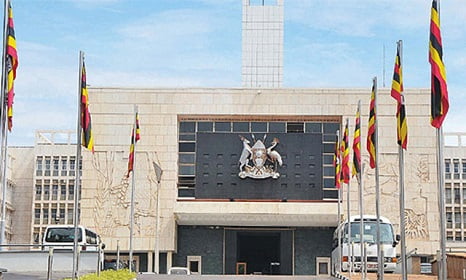
Parliament of Uganda.
The race for Speaker of the 12th Parliament is quietly but steadily taking shape. While incumbent Speaker Anita Among has indicated interest in retaining the position, a crowded and politically significant field is emerging. Justice Minister Norbert Mao, State Minister Persis Namuganza, and Mbale City Woman MP Lydia Wanyoto have all declared or signalled interest.
Yet beneath the surface manoeuvring, multiple political currents appear to be converging in Mao’s favour—currents that could fundamentally unsettle Among’s grip on the Speakership.
The Acholi Factor and Regional Balancing
At the start of the 11th Parliament, the Acholi sub-region held two of the country’s most powerful offices: Jacob Oulanyah as Speaker of Parliament and Owiny Dollo as Chief Justice. Oulanyah’s death in office and Dollo’s recent retirement have left Acholi without representation at the very top of government.
Dollo’s replacement, Chief Justice Flavian Zeija, hails from Kigezi, effectively closing the door on Acholi reclaiming the judiciary’s top seat in the near term. In the context of Uganda’s long-standing practice of regional balancing, the Speakership now stands out as the most viable avenue for restoring Acholi’s presence in high national office.
For a President deeply attentive to regional equilibrium, this reality cannot be ignored.
Mao and the PLU Calculus
Norbert Mao’s political rehabilitation did not happen in isolation. His growing centrality within government circles is closely tied to the Patriotic League of Uganda (PLU) project, widely understood to be overseen by CDF Gen. Muhoozi Kainerugaba.
Mao’s long-standing working relationships with Attorney General Kiryowa Kiwanuka and lawyer Edwin Karugire are not incidental; they are part of a broader political ecosystem that has steadily brought Mao closer to the system’s core.
Crucially, the PLU’s footprint in Parliament—estimated at over 100 MPs—offers Mao a ready-made support base. In a Speakership contest where numbers and quiet alliances matter more than public declarations, this bloc could prove decisive.
Gen. Saleh and the Gulu Strategy
Gen. Caleb Akandwanaho (Salim Saleh)’s sustained presence and activity in Gulu is not accidental. Gulu is being positioned as a future industrial and commercial hub—an inland gateway linking Uganda to DRC, South Sudan, and Sudan, much like Jinja once anchored eastern Uganda’s industrial growth.
Saleh’s proximity to Mao, both politically and personally, adds another layer. Elevating Mao to the Speakership would not only reward an ally but also symbolically anchor Acholi more firmly within the ruling power structure, reinforcing government legitimacy in the region.
The Opposition Question—and Among’s Waning Utility
For much of the 11th Parliament, Among’s political value has been tied to her ability to neutralise and co-opt opposition heavyweights. The recent defection of FDC Vice President for Central Region Yusuf Nsibambi is the latest example.
However, as President Museveni increasingly asserts that the opposition is politically spent, critics argue that the strategic utility of such a role is diminishing. If the opposition is no longer perceived as a threat, then Among’s function as a political enforcer loses urgency.
Other roles within the NRM—such as her position as Vice Chairperson (Female)—could absorb her without the institutional risks that now trail the Speakership.
Mao’s Personal Advantage
Mao himself is a formidable contender. A seasoned lawyer, former local government leader, and parliamentarian, he combines legal fluency with political theatre. Few in Ugandan politics can match his rhetorical dexterity or institutional memory.
While Among has publicly stated that Mao does not scare her, the structural forces aligning behind him suggest otherwise. Region, numbers, military-linked political projects, and personal competence all point in one direction.
The Image of Parliament
Finally, there is the matter of optics. Parliament’s image has taken sustained hits—from corruption allegations to international sanctions. There is growing sentiment within elite circles that the institution requires image rehabilitation.
A Mao Speakership, with its reformist language and symbolic regional rebalancing, could be framed as a reset.
Conclusion
Taken together—Acholi’s exclusion from top offices, the PLU’s parliamentary strength, Gen. Saleh’s northern strategy, a diminished opposition threat, and Mao’s personal credentials—the political weather appears to be shifting.
Whether quietly or dramatically, Anita Among has reasons to worry.
About The Author


