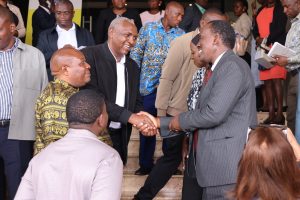

Uganda's Otunnu addressing the Security Council
Carolyn Rodrigues Birkett of Guyana moved into first place in the race to become the next United Nations secretary-general among eight candidates so far, after the Security Council held its second secret straw poll, on Friday, Aug. 21. Uganda’s Olara Otunnu gained the sharpest percentage increase support for his candidacy. Yet no nominee drew the required nine yes votes from the Council poll to fully command a lead.

Rodrigues Birkett received eight “encourage,” three “discourage” and four “no opinion” ballots, putting her narrowly ahead of Costa Rica’s Rebeca Grynspan. Grynspan got seven encourage, four discourage and four no opinion. She led the first round of straw polls, held July 30, with 10 encourage, 1 discourage and 4 no opinion.
Rafael Grossi of Argentina also received seven encourage votes on Aug. 21, but six discourage and two no opinion. Macky Sall of Senegal recorded six encourage votes, seven discourage and two no opinion.
Olara Otunnu of Uganda drew five encourage votes, five discourage and five no opinion.
María Fernanda Espinosa of Ecuador (nominated by Antigua and Barbuda) received four encourage votes, three discourage and eight no opinion.
Michelle Bachelet of Chile (nominated by Brazil and Mexico) drew just two encourage votes, six discourage and seven no opinion.
Ivonne A-Baki of Ecuador (nominated by Tonga), who joined the race after the first poll was held, received no encourage votes, eight discourage and seven no opinion.
Surprising results
Otunnu’s outcome reflected one of the clearest shifts from the July round of informal voting. As a relative latecomer to the race, who held his interactive dialogue with the General Assembly on Aug. 20, as part of the selection process, he more than doubled his encourage votes (from two to five). Some of the eight original no-opinion ballots he drew in July flipped into support in the second polling.
He still fell short of nine yes votes, the minimal tally required for any candidate to clinch the top UN leadership position under Article 27 of the UN Charter (not including a veto, which is not cast in the straw polls). A substantive Council decision requires nine affirmative votes, including the concurrence of the permanent members.
“It is no surprise that some of the candidates have gained or lost ground, particularly as the P5 begin to express their preferences more openly,” said Daniel Forti, the head of UN affairs at the International Crisis Group think tank, referring to the five permanent members (Britain, China, France, Russia and US).
“No candidate has commanded a significant majority of Council members after two polls, which may convince others potential candidates that they now have an opportunity to jump into the race.”
About The Author