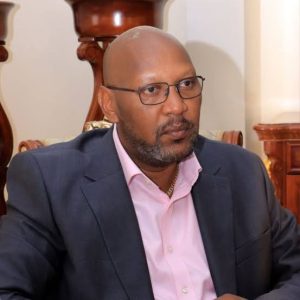


Some of the promoted officers being decorated on Monday.
The recent promotion of senior Uganda People’s Defence Forces (UPDF) officers is already drawing attention beyond military circles, with analysts viewing the changes as strategically significant ahead of the 2026 general elections.
Days ago, a number of senior officers were decorated following their earlier promotions, reshaping the command structure of the UPDF and related security institutions at a politically sensitive moment.
Among the most notable promotions was that of Jack Bakasumba, the Chief of Joint Staff, and Francis Okello, the Commandant of the National Defence College–Uganda, both elevated from Major General to Lieutenant General. Their roles place them at the core of strategic planning, coordination, and doctrinal guidance within the military establishment.
Several officers were also promoted from Brigadier to Major General, including James Kinaalwa, the Joint Staff–Human Resource Management, Deus Sande, Commandant of the UPDF Armoured Division, Charles Byanyima, Commandant of the Motorised Infantry, William Bainomugisha, Commandant of the Military Police, and Christopher Damulira, the Director of Crime Intelligence in the Uganda Police Force.
Additionally, Paddy Ankunda, the Assistant Chief of Defence Intelligence and Security (ACDIS-DEIA)—formerly CMI—and McDans Kamugira, a close aide to the Chief of Defence Forces and currently Uganda’s military attaché to Kenya, were promoted to the rank of Brigadier General.
Taken together, these positions sit at the intersection of intelligence, internal security, force discipline, mobility, logistics, and strategic coordination—all areas that traditionally become more pronounced during election cycles.
Historically, the UPDF and allied security agencies play a visible role during elections through deployments related to crowd control, protection of key installations, intelligence gathering, and coordination with the Uganda Police Force. Units such as the Military Police, Armoured Division, Motorised Infantry, and Defence Intelligence are particularly central to election-period security operations.
The elevation of officers who already command these sensitive formations strengthens continuity, loyalty, and command clarity within the security architecture as the country heads into a high-stakes political season. It also signals confidence by the Commander-in-Chief in officers considered reliable, experienced, and aligned with the broader state security posture.
While the Electoral Commission remains constitutionally mandated to manage elections, the reality of Uganda’s electoral environment means that security leadership decisions inevitably influence how elections are policed, perceived, and managed on the ground.
As 2026 approaches, the newly promoted UPDF chiefs are therefore expected to play a decisive role—not in electoral competition itself, but in shaping the security environment, enforcement posture, and stability framework within which the polls will be conducted.
About The Author