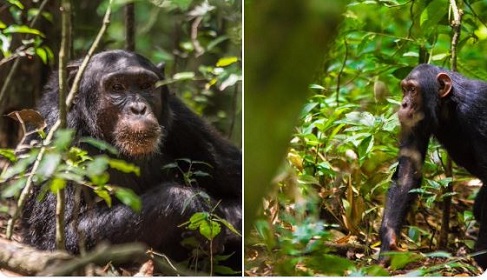
Kibale National Park — A rare and prolonged internal conflict within one of the world’s largest chimpanzee communities has left at least 24 individuals dead, raising concern among conservationists and researchers.
The Ngogo chimpanzee community, located in Kibale National Park, has for more than two decades been known for its unusually large and stable population of about 200 individuals. However, that stability has been disrupted by what experts are describing as a “chimpanzee civil war.”
According to the Uganda Tourism Board, the conflict has so far claimed 24 chimpanzees, including 17 infants and seven adult males.
Researchers say the violence emerged gradually over several years, with early signs appearing around 2015. During this period, the once cohesive group began to fragment into smaller factions, particularly among dominant males.
Communication between sub-groups declined, reconciliation became rare, and interactions increasingly shifted from cooperation to avoidance and hostility.
By 2018, the divisions had hardened, with rival factions establishing territorial boundaries and competing for control of key areas.
Scientists also point to a series of destabilising events that may have contributed to the breakdown of social cohesion. In 2014, six chimpanzees died under unclear circumstances, followed by the overthrow of a dominant male leader the following year—an event that significantly altered the group’s power structure.
An outbreak of disease later killed about 25 chimpanzees, including an individual believed to have played a key role in maintaining links between the emerging factions. His death is thought to have accelerated the division.
Chimpanzees are among the most intelligent primates, sharing approximately 98.8 percent of human DNA. Their social systems—characterised by alliances, hierarchy, and territoriality—closely resemble those of humans, making the Ngogo conflict particularly significant to researchers.
While isolated violent encounters among chimpanzees have been documented, sustained internal conflict of this scale is considered extremely rare.
The development has also raised conservation concerns, as chimpanzees are listed among endangered species. Experts warn that continued losses within such a key population could have long-term implications for both research and conservation efforts.
The Ngogo case is now being closely studied as a rare example of how social breakdown, leadership struggles, and environmental pressures can converge to trigger prolonged conflict—even among one of humanity’s closest relatives.